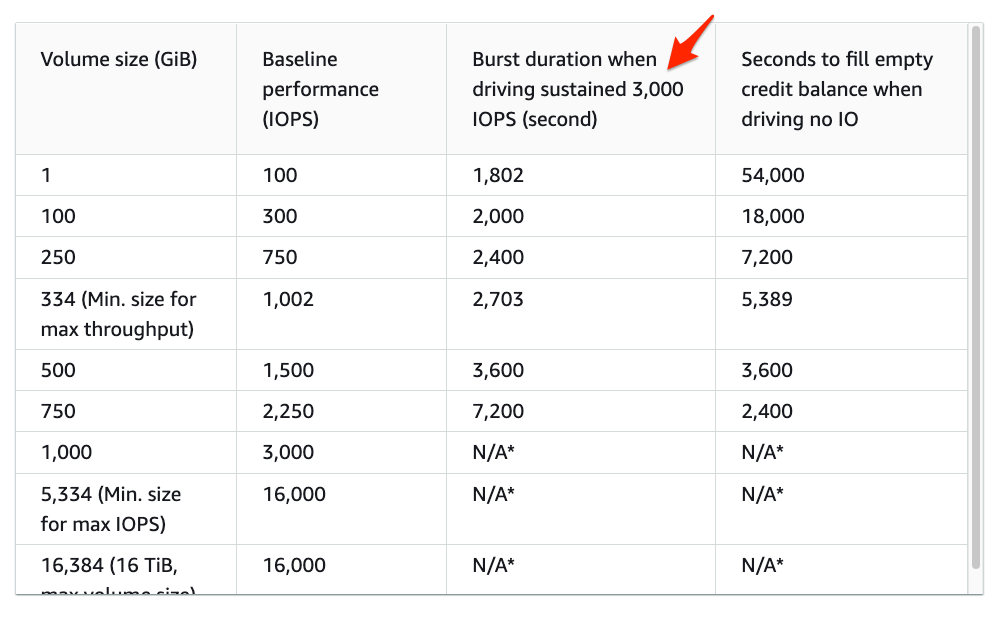
In this gp2 burst duration table taken from the AWS document, why is the burst duration column increases as the volume size increases? I mean at 100 GB, the burst duration for 3,000 iops is 2,000 seconds (so, 33 mins). But when the size becomes 750GB, the duration for 3,000 iops is 7,200 seconds (so, 120 mins.).
Shouldn’t this trend be opposite? The bigger the size, the lesser burst duration that it can sustain since 3,000 iops for a bigger size uses more resources?
Then there is this line which made me more confused: “Each volume receives an initial I/O credit balance of 5.4 million I/O credits, which is enough to sustain the maximum burst performance of 3,000 IOPS for at least 30 minutes” … it seems to put a cap to the burst duration of 30 minutes, and yet the table shows 120 minutes for 750GB size. Is my interpretation incorrect?
No the docs are right. Bigger the provisioned size, more bandwidth, IOPS and burst duration you’re getting.
Think of it like this: your volume is carved out of a much bigger storage system. When your volume is small, you share the big system with lots of other volumes. When it’s big, you get much bigger share of everything, not only size but also of networking.
The bigger the size, the lesser burst duration that it can sustain since 3,000 iops for a bigger size uses more resources?
IOPS are calculated at a fixed size, so the workload is exactly the same. A bigger volume accrues more credits, faster, so of course it can burst longer.