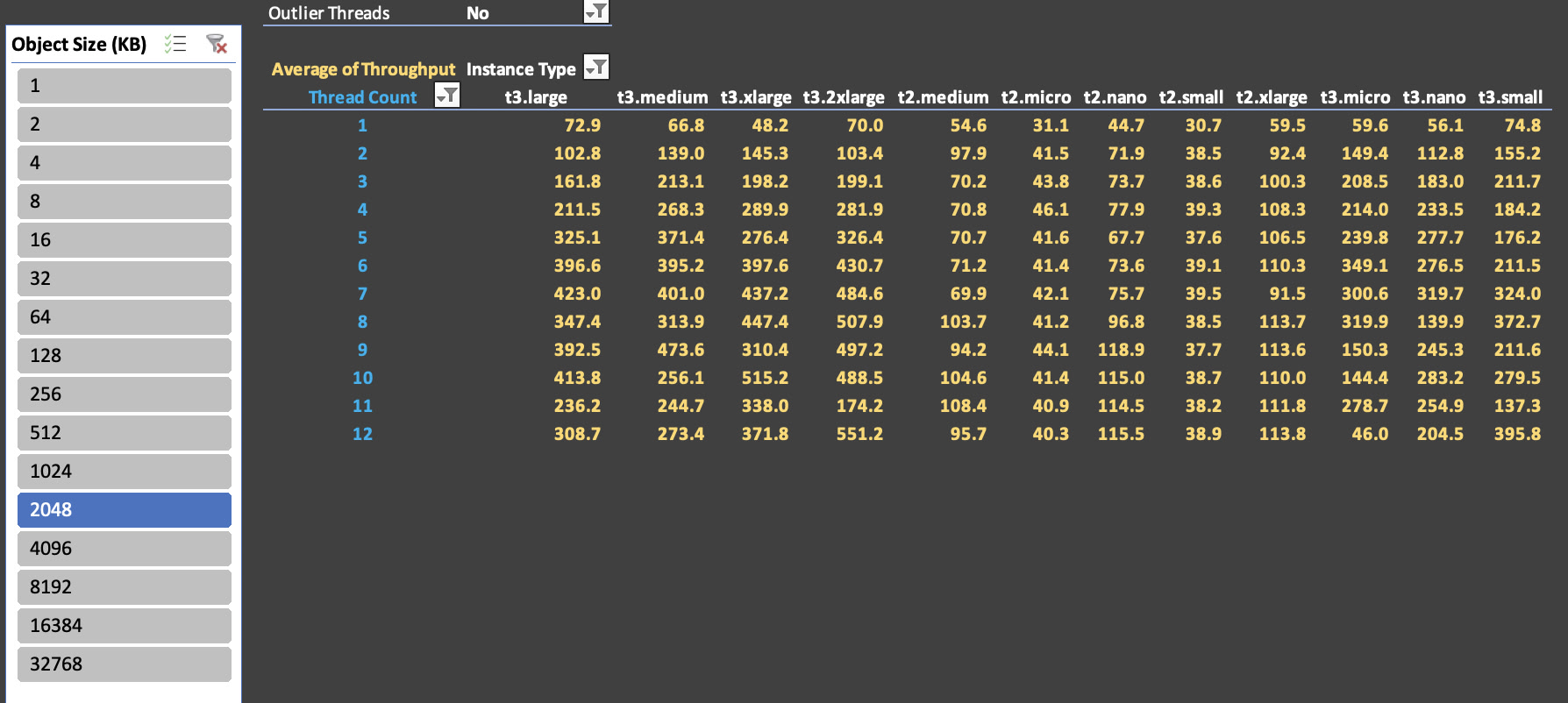
Hello r/aws - Yesterday I open sourced a tool to measure the bandwidth between S3 and any host: https://github.com/dvassallo/s3-benchmark. Then I used this to benchmark S3’s performance from all 155 EC2 instance types in existence. I put all the data in an interactive spreadsheet that you can download here. Feel free to share it with you friends and colleagues. Below is the max throughput I got from each instance type, but the spreadsheet shows you what object sizes and thread counts you need to get that performance.
| EC2 Instance Type | Max S3 Throughput MB/s |
|---|---|
| c5n.18xlarge | 8,003 |
| p3dn.24xlarge | 6,269 |
| c5n.9xlarge | 5,741 |
| c5n.2xlarge | 2,861 |
| c5n.4xlarge | 2,851 |
| r5.metal | 2,718 |
| z1d.12xlarge | 2,718 |
| r5d.24xlarge | 2,718 |
| i3.metal | 2,716 |
| r5.24xlarge | 2,714 |
| m5d.24xlarge | 2,714 |
| r4.16xlarge | 2,714 |
| h1.16xlarge | 2,713 |
| m5.metal | 2,713 |
| x1.32xlarge | 2,711 |
| c5d.18xlarge | 2,710 |
| c5.18xlarge | 2,710 |
| p3.16xlarge | 2,710 |
| x1e.32xlarge | 2,709 |
| m5.24xlarge | 2,709 |
| z1d.metal | 2,708 |
| i3.16xlarge | 2,707 |
| f1.16xlarge | 2,706 |
| m4.16xlarge | 2,705 |
| g3.16xlarge | 2,705 |
| p2.16xlarge | 2,702 |
| m5d.metal | 2,673 |
| m5a.24xlarge | 1,801 |
| m5ad.24xlarge | 1,706 |
| r5ad.24xlarge | 1,699 |
| r5a.24xlarge | 1,562 |
| c5n.xlarge | 1,543 |
| x1.16xlarge | 1,410 |
| p2.8xlarge | 1,409 |
| g3.8xlarge | 1,400 |
| x1e.16xlarge | 1,400 |
| r4.8xlarge | 1,400 |
| i3.8xlarge | 1,400 |
| p3.8xlarge | 1,400 |
| h1.8xlarge | 1,399 |
| c5.9xlarge | 1,387 |
| r5.12xlarge | 1,387 |
| z1d.6xlarge | 1,387 |
| m5.12xlarge | 1,387 |
| m5d.12xlarge | 1,387 |
| c5d.9xlarge | 1,387 |
| r5d.12xlarge | 1,386 |
| g3.4xlarge | 1,163 |
| r4.4xlarge | 1,163 |
| f1.4xlarge | 1,163 |
| i3.4xlarge | 1,162 |
| x1e.8xlarge | 1,162 |
| h1.4xlarge | 1,161 |
| h1.2xlarge | 1,161 |
| x1e.4xlarge | 1,160 |
| m5.4xlarge | 1,157 |
| r5a.4xlarge | 1,156 |
| r5.4xlarge | 1,156 |
| r5d.4xlarge | 1,156 |
| m5a.12xlarge | 1,156 |
| m5d.4xlarge | 1,156 |
| m5ad.4xlarge | 1,156 |
| c5d.4xlarge | 1,156 |
| r5ad.12xlarge | 1,156 |
| c5.4xlarge | 1,156 |
| m5ad.12xlarge | 1,156 |
| r5a.12xlarge | 1,156 |
| m5a.4xlarge | 1,155 |
| r5ad.4xlarge | 1,155 |
| z1d.3xlarge | 1,155 |
| a1.4xlarge | 1,153 |
| i3.2xlarge | 1,143 |
| p3.2xlarge | 1,142 |
| x1e.2xlarge | 1,138 |
| f1.2xlarge | 1,137 |
| r5ad.2xlarge | 1,136 |
| m5d.2xlarge | 1,136 |
| r4.2xlarge | 1,135 |
| r5d.2xlarge | 1,134 |
| m5.2xlarge | 1,133 |
| z1d.2xlarge | 1,132 |
| m5ad.xlarge | 1,132 |
| c5d.2xlarge | 1,132 |
| m5a.2xlarge | 1,132 |
| m5ad.2xlarge | 1,131 |
| r5a.2xlarge | 1,131 |
| c5.2xlarge | 1,131 |
| r5ad.xlarge | 1,130 |
| r5.2xlarge | 1,129 |
| r4.xlarge | 1,127 |
| m5a.xlarge | 1,125 |
| g3s.xlarge | 1,124 |
| r5a.xlarge | 1,123 |
| i3.xlarge | 1,119 |
| z1d.xlarge | 1,116 |
| m5.xlarge | 1,114 |
| c5.xlarge | 1,114 |
| m5d.xlarge | 1,114 |
| r5.xlarge | 1,114 |
| r5d.xlarge | 1,113 |
| c5d.xlarge | 1,113 |
| i2.8xlarge | 1,092 |
| d2.8xlarge | 1,066 |
| c4.8xlarge | 1,066 |
| m4.10xlarge | 1,066 |
| z1d.large | 1,002 |
| x1e.xlarge | 980 |
| c5.large | 949 |
| a1.2xlarge | 944 |
| c5d.large | 942 |
| r5d.large | 936 |
| m5d.large | 891 |
| m5.large | 873 |
| c5n.large | 851 |
| r5.large | 846 |
| r5ad.large | 783 |
| m5ad.large | 762 |
| r5a.large | 740 |
| a1.xlarge | 737 |
| m5a.large | 726 |
| i3.large | 624 |
| t3.2xlarge | 569 |
| t3.xlarge | 568 |
| t3.medium | 558 |
| t3.large | 553 |
| d2.4xlarge | 544 |
| c4.4xlarge | 544 |
| r4.large | 541 |
| a1.large | 514 |
| t3.small | 395 |
| t3.micro | 349 |
| t3.nano | 319 |
| c4.2xlarge | 272 |
| d2.2xlarge | 272 |
| m4.4xlarge | 246 |
| i2.4xlarge | 244 |
| g2.8xlarge | 237 |
| a1.medium | 169 |
| p2.xlarge | 154 |
| t2.nano | 118 |
| m4.2xlarge | 118 |
| i2.2xlarge | 118 |
| g2.2xlarge | 118 |
| t2.2xlarge | 116 |
| t2.xlarge | 113 |
| t2.large | 109 |
| t2.medium | 108 |
| c4.xlarge | 102 |
| d2.xlarge | 102 |
| m4.xlarge | 87 |
| i2.xlarge | 80 |
| c4.large | 71 |
| m4.large | 53 |
| t2.micro | 46 |
| t2.small | 39 |
Related discussions:
- Need an optimized sandbox setup for coding agents
- Why are EC2 Mac instances so expensive & who are they actually for?
- Custom domains for a multi-tenant SaaS — CloudFront SaaS Manager vs Caddy vs managed service?
- AWS RDS SQL Server db.t3.micro costing ~$80+/month mostly from CPU credits while app is basically idle — what would you do?
- What are MSPs using for AWS EC2 backups in 2026?